
Meraki (Μερακι)
The Greek Word That Measures Soul, Not Speed

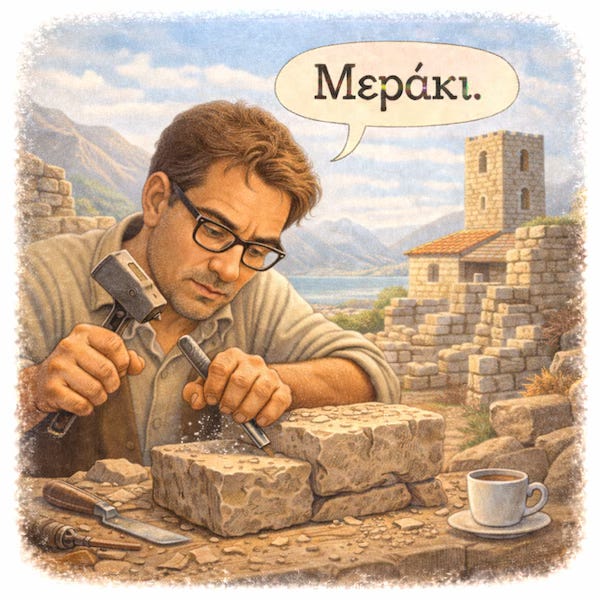
Greeks have a word for doing something with love, pride, patience, and yes, occasionally a little drama.
It’s called meraki (μεράκι).
If you try to translate meraki, you’ll come up with phrases like:
To put your heart and soul into something.
To do something with love and passion.
A labor of love.
To leave a piece of yourself in your work.
To create with soul.
All correct.
All incomplete.
Because meraki isn’t just effort.
It’s presence.
It’s when care becomes visible.
When someone says doulevei me meraki (δουλεύει με μεράκι) — he works with meraki — it means heart is involved. Pride is involved. Patience is built into the process.
Not because someone is watching.
Not because there’s a deadline.
But because the soul refuses to sign off early.
You can taste it.
You can hear it.
You can feel when it’s missing.
A meraklidiko (μερακλίδικο) dish isn’t fancy.
It’s just right.
The sauce stayed on the stove a little longer.
The oregano was adjusted by instinct.
The rim of the plate wiped clean before serving, the quiet signature of someone who cared.
That’s meraki.
A meraklis (μερακλής), or a meraklou (μερακλού) isn’t necessarily the most talented person in the room.
They’re the ones who stay five minutes longer.
Sand the wood one more time.
Tune the instrument again.
Fix something that technically wasn’t broken.
They simply can’t help themselves.
When a Greek says
echo meraki na matho kithara (έχω μεράκι να μάθω κιθάρα),
they’re not saying, “I might try to play the guitar.”
They’re saying:
I will struggle.
I will sound terrible at first.
I will keep going anyway.
Meraki forgives imperfection.
It never forgives indifference.
And then there’s the moment when me epiasan ta merakia mou (με έπιασαν τα μεράκια μου).
An emotional wave catches you.
Sometimes it makes you cook.
Sometimes it makes you repair something old.
Sometimes it makes you stare at the sea longer than necessary.
And sometimes…
Someone meraklothike (μερακλώθηκε).
A bouzouki stretches a note just a little too long.
The tsipouro has quietly done its work.
The right song lands at exactly the wrong time.
A chair scrapes back.
Someone jumps on the table.
The parea claps.
Carnations fly.
A plate fulfills its destiny.
That too is meraki.
Not the sanding-the-wood kind.
The kind that rises from your chest and refuses to sit politely in a chair.
Living in Greece, you start seeing meraki everywhere.
In the kafeneio where the coffee is always the same, and always perfect.
In the mechanic who tightens something “just in case.”
In the neighbor who insists you take food home because it turned out well.
And after seeing it everywhere, curiosity did what curiosity does.
Out of curiosity, and mild to severe obsession, I typed Meraki into Google Maps and zoomed out.
Then I zoomed out again.
And again.
What appeared looked less like search results and more like a national personality trait.
Pins everywhere.
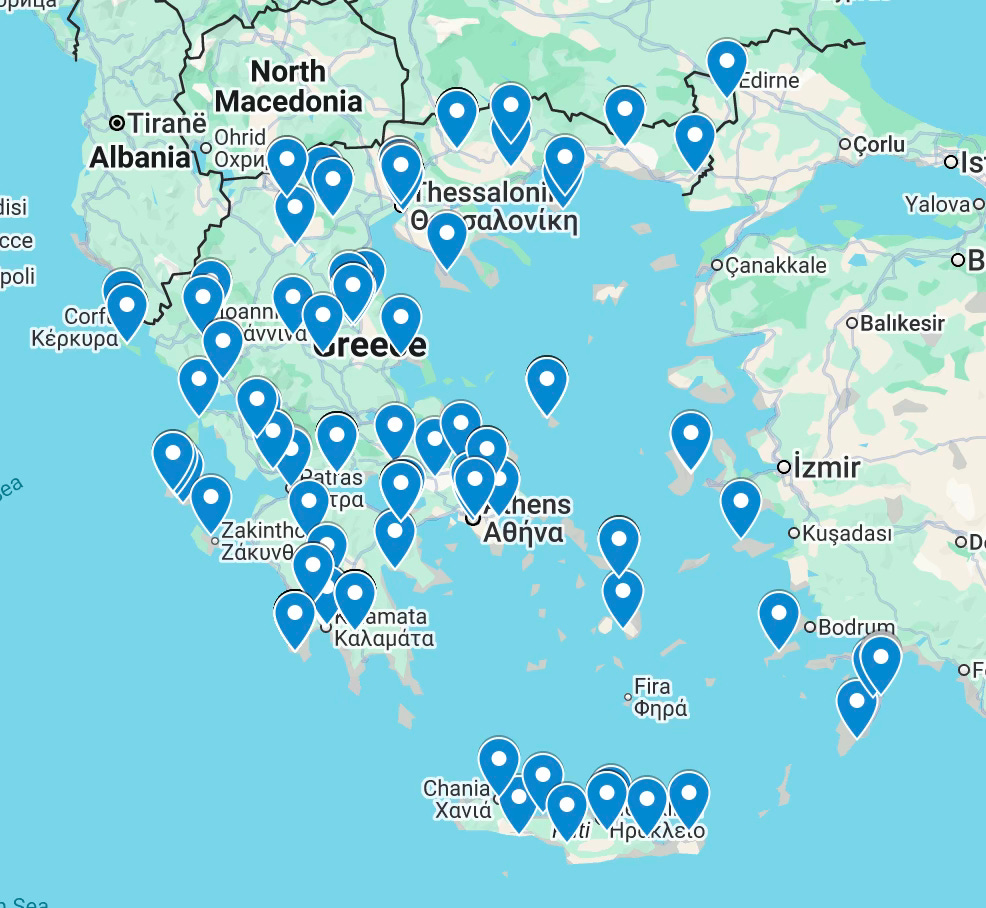
Mainland. Islands. Mountain villages. Tourist hubs.
Places you’ve heard of. Places only the postman knows.
At last count before I gave up:
181 “Meraki” establishments.
Restaurants. Taverns. Cafés. Hotels. Apartments. Businesses quietly declaring the same thing:
We care.
Three in Kalamata and six in Messinia alone.
Of course.
But even this map is incomplete.
Because it only shows the places with signage.
It doesn’t show:
The yiayia rolling phyllo before sunrise.
The carpenter restoring a centuries-old wooden piece one brushstroke at a time.
The souvlaki place where they start your order when they see you turning the corner.
Those don’t get pins.
They just get remembered.
It’s why things here can be slow.
And why, when they’re good, they’re really good.
Meraki doesn’t rush.
It lingers.
Somewhere along the way, many of us traded meraki for efficiency.
We optimized.
We scaled.
We met deadlines.
We stopped asking whether something was made with care — or just completed.
In America, they ask:
“Is it efficient?”
In Greece, they ask:
“Is it made with meraki?”
One measures time.
The other measures soul.
Guess which one tastes better.
What’s something in your life you do with meraki?
Cooking.
Writing.
Fixing old doors in Mani.
Dancing on tables.
Because the world could use a little more of it.
My wife smiles, shakes her head, and calls me meraki mou (μεράκι μου). 💙
Siga siga (σιγά σιγά).
Nick in Kalamata
the word "μεράκι" along with the one "φιλότιμο" are the hardest ones to translate. Btw you should write about filotimo, too. Unless you have already done it.
Γραμμένο με μεράκι 😀! Διαβάζω τέτοια άρθρα και αναπολώ! Θα έλεγα τέτοιες λέξεις υπάρχουν αρκετές. Πέρα από το φιλότιμο θα έλεγα ένα άρθρο για την έννοια της λεβεντιάς θα ήταν ευπρόσδεκτο!