
Καημός (Kaimós)
The quiet ache that arrives after the moment ends.

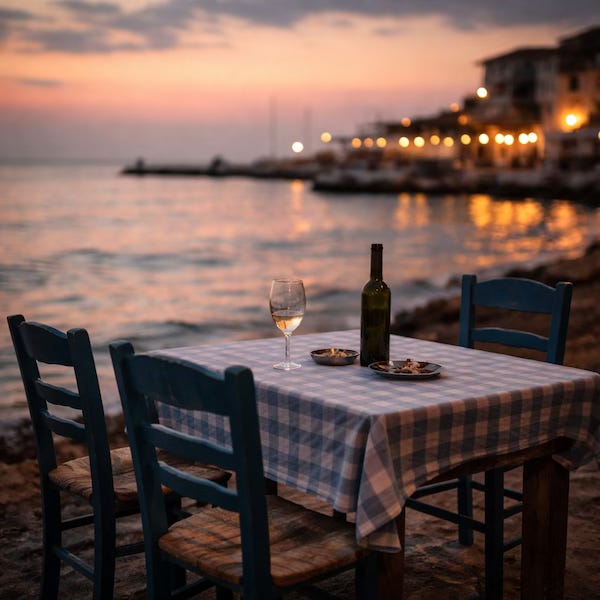
Not quite sadness. Not quite nostalgia. Greeks have a word for the feeling that lingers after the music stops and the table goes quiet.
There are Greek words you struggle to translate.
And then there are words that simply refuse to cooperate.
Καημός — kaimós.
You can try to call it sadness.
Or longing.
Or nostalgia.
None of them quite work.
Because kaimós isn’t the feeling during the moment.
It’s the feeling after the moment leaves.
The evening ends.
The music stops.
The last glass of wine is empty.
The table that was loud with stories is suddenly quiet.
And something stays behind.
That something is kaimós.
In Greece it shows up in very specific places.
In the last song of the night when someone insists on playing one more rebetiko talking about agapi (love).
In the moment when the boat pulls away from the dock and someone on shore lifts their hand in a slow wave.
In the quiet drive home after a panigyri, when the clarinet is still ringing somewhere in the back of your head.
In the café when the chairs are stacked, the street is empty, and the owner wipes the same table three times even though it’s already clean.
Greeks even have a phrase for a very particular version of it:
καημός της ξενιτιάς
(kaimós tis xenitiás)
The ache of being away from home.
Not just missing a place.
Missing the version of yourself who once lived there.
But kaimós doesn’t only live in poetry and old songs.
It also appears in everyday Greek family life.
For example:
ο καημός της μάνας
(o kaimós tis manas)
The mother’s ache.
The son refuses to go to university.
Or worse.
He goes to university… and comes back with a degree in something nobody understands.
Or he moves to Athens.
Or even worse.
He refuses to marry the very nice girl from Kalamata whose mother has already mentally arranged the baptism of the grandchildren.
This too… is kaimós.
But kaimós isn’t dramatic.
It doesn’t shout.
It doesn’t make a scene.
It just sits quietly in the corner like the last cigarette in an ashtray after everyone has gone home.
And Greeks don’t really try to fix it.
They pour another small glass of wine.
They play another song.
They tell another story.
Not to cure the kaimós.
Just to keep it company.
Because sometimes that lingering ache is simply proof that something mattered.
That the night was good.
That the company was right.
That the moment was worth having.
And in Greece, when that quiet feeling stays behind after everything else has gone…
we don’t call it sadness.
We call it καημός (kaimos).
Which, coincidentally, is also the feeling you get the morning after a panigyri when you realize you promised three different people you would visit them “soon.”
And now, apparently, you have five new cousins in Kalamata 🇬🇷
Greek words that refuse to translate, but somehow explain everything.
Have you ever felt kaimós?
That quiet moment after something beautiful ends —
a trip, a summer night, a place you once lived,
or even just a table that stayed a little too long.
Tell me in the comments.
Because sometimes the most powerful feelings
arrive after the story is over.
Siga, siga 💙
Nick in Kalamata
I felt it as I was reading your very apt words. I didn't understand it as a child yet now as an adult I feel it strongly. You've described this feeling beautifully. Thank you.
Κάθε λιμάνι και καημός , κάθε καημός και δάκρυ που έλεγε κι ο ποιητής πατριώτη!